
House View
House View Q3 2026: Shock absorption

Our view of global markets
Selectivity matters
- The global economy is bending under successive shocks, but not breaking. Following the disruption from US tariffs, the Middle East crisis now appears to be stabilising. But oil prices remain elevated, inflation is still above target in most major economies, and the macro backdrop remains vulnerable to renewed volatility ahead of the US mid-term elections.
- What matters for investors is not just market direction, but the range of possible outcomes. Gaps across regions, asset classes and narratives are widening: the US remains relatively resilient, while Europe and parts of Asia are more sensitive to shifts in energy supply and prices. Markets are sending conflicting signals, with bonds pointing to a more stagflationary path while equities reflect a more optimistic growth backdrop.
- This divergence is playing out within asset classes. Elevated inflation risk and higher-for-longer rates are shifting attention towards value, income and quality, while AI-led investment supports growth and valuations in parts of the market. Correlations between equities and bonds have risen, making diversification less straightforward and reinforcing the case for a broader toolkit.
- In this environment, beta alone is unlikely to be sufficient. Returns will depend on careful choices – across countries, sectors and instruments – and the ability to adapt.
- The durability of any relief rally depends on sustained normalisation of energy flows through the Strait of Hormuz and a credible political settlement. Our base case remains one of resilience – but markets are pricing a reduction in risk, not its removal.

Chart of the quarter
US tech investment reaches new highs
US IT investment has exceeded its dot‑com era peak as a share of GDP, underlining how the AI cycle is strengthening rather than fading. As this investment broadens beyond a narrow group of firms, identifying the winners becomes more critical for investors – and more challenging.
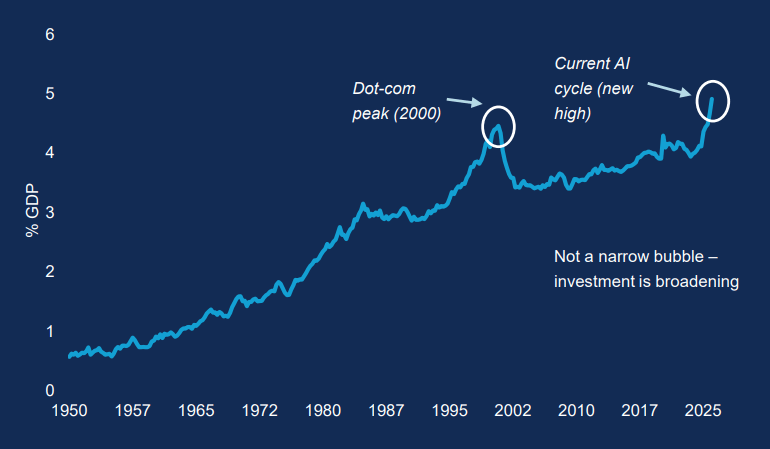
Source: Bloomberg and AllianzGI Economics & Strategy (data as at May 2026).
Short on time? Download the summary of our House View Q3.